

Due Diligence & Termination Fee in SC: What Buyers Must Know
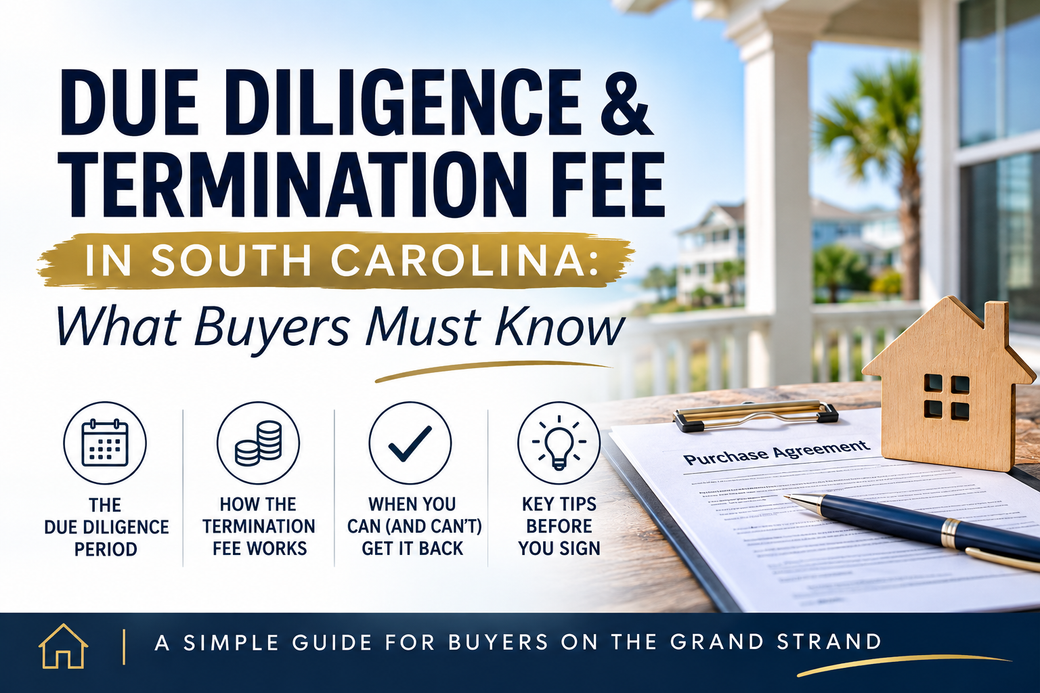
📋 Grand Strand Buyer’s Guide
Due Diligence and Earnest Money on the Grand Strand: What Every Buyer Needs to Know
Two terms that confuse almost every buyer — and cost some of them real money when they get it wrong.
Coastal Carolina Group | INNOVATE Real Estate — November 2026
In South Carolina, due diligence is a negotiated inspection period — typically 10 to 14 days — during which you can terminate the contract for any reason and get your earnest money back. If you exit during this window for due diligence reasons, you owe the seller a negotiated Termination Fee. That fee is not owed if you exit under a different contingency like financing or appraisal. Knowing the difference protects your money.
Most buyers hear these two terms for the first time when they’re sitting across a table reviewing an offer. They nod along and figure it out later — and sometimes that works out fine. Sometimes it costs them $1,000 to $5,000 or more. This guide walks you through exactly how both work in a South Carolina purchase contract, what the norms look like on the Grand Strand, and what you should actually be doing during those critical 10 to 14 days.
⚡ At a Glance: Termination Fee vs. Earnest Money in SC
| Term | Typical Amount | Refundable? |
| Termination Fee | Negotiable — whatever parties agree | No — owed to seller only if buyer exits for DD reasons |
| Earnest Money Deposit | $1,000 – $5,000+ (residential) | Yes — if you exit during DD period |
| Due Diligence Period | 10 – 14 days (negotiable) | Your window to inspect and exit |
What Is the Due Diligence Period in a South Carolina Real Estate Contract?
The due diligence period in a South Carolina real estate contract is a negotiated window — typically 10 to 14 days on the Grand Strand — during which the buyer has the right to investigate the property thoroughly and terminate the contract for any reason. If you exit during this window, your earnest money is returned.
Think of the due diligence period as your investigation window. During this time, you can order inspections, review HOA documents, verify flood zone status, check permits, and do anything else you need to feel confident about the property. If something comes back that changes your mind — a foundation issue, an HVAC system on its last legs, an HOA with a $40,000 special assessment pending — you can exit the contract and receive your earnest money back.
The due diligence period begins when both parties have signed the contract and ends on the agreed-upon date, typically at 6:00 PM. Missing that deadline by even a few hours can have real consequences — your earnest money becomes at risk if you try to exit after the period closes. This is one of several reasons having an experienced local agent managing your timeline matters as much as it does on the Grand Strand.
What Is Earnest Money and How Much Should I Put Down on the Grand Strand?
Earnest money is a good-faith deposit that shows the seller you’re a serious buyer. On the Grand Strand, most residential transactions see earnest money deposits of $1,000 to $5,000. Luxury and waterfront properties often run higher. The deposit is held in escrow and applied toward your closing costs — it is not an extra expense, just an early one.
Your earnest money deposit (EMD) goes into an escrow account held by the closing attorney or brokerage after the contract is signed. It sits there until closing, at which point it is credited toward your down payment or closing costs. If the transaction closes normally, you don’t “lose” it — it was always yours, just moved early.
The question of how much to put down matters competitively. In a multiple-offer situation — which still happens regularly in well-priced communities like Waterbridge, the Barefoot Resort area of North Myrtle Beach, and new construction neighborhoods in Carolina Forest — a larger earnest money deposit signals commitment to the seller. We coach buyers on how to structure both the Termination Fee and the EMD to make their offer as competitive as possible without overexposing their cash.
For waterfront and luxury properties — ICW homes, oceanfront condos, properties above $700,000 — earnest money deposits of $10,000 to $25,000 are not unusual. The percentage norms shift as the price point rises.
What’s the Difference Between Due Diligence and Earnest Money in SC?
The Termination Fee is negotiable, goes directly to the seller at contract signing, and is kept by the seller if the buyer terminates during the DD period for due diligence reasons. Earnest money is held in escrow and is refundable if you exit during the due diligence period. These are two separate payments with two very different risk profiles.
This distinction trips up buyers constantly, especially those coming from states that don’t use this structure. In South Carolina, the Termination Fee is essentially the cost of buying yourself the right to investigate — it’s negotiated between buyer and seller and paid to the seller upfront at contract signing. If you terminate during the DD period for due diligence reasons, that fee stays with the seller. If you exit under a different contingency — financing, appraisal, CL-100 — the Termination Fee is not owed.
The earnest money, on the other hand, is protected during the due diligence period. If you terminate before the DD deadline — for any reason, no explanation required — your earnest money comes back to you. After the due diligence period closes, the earnest money is at risk if you exit without a contract-specific contingency to cover you (appraisal contingency, financing contingency).
One practical way to think about it: the Termination Fee is what you pay for the right to change your mind during the DD period. The earnest money is what you’re risking if you change your mind after that window closes without a valid contingency covering you.
What Happens to My Earnest Money If I Back Out of the Deal?
If you back out during the due diligence period, your earnest money is fully refundable — no questions asked. If you back out after the due diligence period closes without a valid contingency protecting you, the seller may be entitled to keep your earnest money as liquidated damages. The timing of your exit is everything.
The SC standard residential purchase contract gives buyers significant protection during the due diligence period — you can walk away for any reason, from cold feet to a bad inspection, and your deposit is returned. This is by design. The DD period exists precisely to give buyers a risk-managed window to investigate before they’re truly committed.
Once the due diligence period expires, your remaining protection comes from contingencies written into the contract. The most common are the financing contingency (if your loan falls through, you can exit and recover your EMD) and the appraisal contingency (if the property appraises below purchase price and the seller won’t negotiate, you can exit). If you have no contingencies remaining and you decide to walk — for personal reasons, change of heart, found something better — the seller typically has a valid claim to your earnest money.
The practical takeaway: use the due diligence period seriously. Don’t wait until day 12 of a 14-day period to schedule your inspections. If you are going to exit, exit before the deadline — cleanly and in writing.
What Should I Actually Do During the Due Diligence Period?
During the due diligence period, you should order every inspection relevant to the property, review the HOA documents, verify flood zone status and elevation certificate if applicable, confirm insurance costs, and assess any repairs or credits you want to negotiate before the DD deadline. This window is your one protected opportunity to do all of it.
Day one of the DD period should trigger immediate action, not a waiting period. Good inspectors in the Grand Strand market — particularly during busy spring and fall buying seasons — book out quickly. We recommend that buyers have an inspector identified before they go under contract so scheduling happens within 24 to 48 hours of signing.
📋 Due Diligence Period Checklist
✅ Schedule general home inspection (Day 1–2)
✅ Schedule WDO/termite inspection
✅ Schedule HVAC inspection if flagged
✅ Request roof inspection or review age/condition
✅ Review HOA documents: CC&Rs, budget, meeting minutes, special assessments
✅ Verify FEMA flood zone; request elevation certificate if in flood zone
✅ Get insurance quotes — especially flood if applicable
✅ Schedule pool inspection if property has pool
✅ Schedule septic inspection if no public sewer (Conway, Longs, rural areas)
✅ Review survey and property lines
✅ Submit repair request or price reduction request to seller before DD deadline
Insurance verification is especially important on the Grand Strand. Flood insurance costs vary dramatically by property, flood zone designation, and elevation — two homes on the same street can have very different annual premiums. Discovering that a home in a flood zone carries a $6,000 annual flood insurance requirement is the kind of information that changes the math on a purchase. Find that out during due diligence, not at closing.
What Inspections Do I Need on a Grand Strand Property?
At minimum: a general home inspection and a WDO (wood-destroying organism / termite) inspection. The Grand Strand’s coastal climate makes termite activity genuinely common — this is not optional. Depending on the property, you may also need a roof inspection, HVAC inspection, pool inspection, septic inspection, sewer scope, or elevation certificate review. We recommend all relevant ones for every buyer we work with.
| Inspection Type | When You Need It | Approx. Cost |
| General Home Inspection | Every purchase | $300 – $500 |
| WDO / Termite Inspection | Every purchase in SC | $75 – $150 |
| Roof Inspection | Roof age unknown / flagged | $150 – $350 |
| HVAC Inspection | System age 8+ years | $100 – $250 |
| Pool Inspection | Property has pool | $150 – $300 |
| Septic Inspection | Conway, Longs, rural areas | $200 – $450 |
| Elevation Certificate Review | Flood zone / waterfront | Varies; get from seller or survey |
South Carolina’s warm, humid coastal climate is genuinely active termite territory — Myrtle Beach, Conway, Murrells Inlet, and the entire coastal plain have conditions that support year-round termite activity. The WDO inspection is not a checkbox formality here. We have seen it uncover active infestations and significant prior damage that changed the direction of transactions. Do not skip it.
What Happens After Due Diligence Ends?
Once the due diligence period closes, the contract moves toward closing and your earnest money is now at risk if you exit without a valid contingency. Any repair requests or price renegotiations should be submitted in writing before the DD deadline — after it passes, you’re negotiating from a weaker position and the seller has less incentive to accommodate.
The end of the due diligence period is a significant milestone in the transaction. At this point, the buyer has either accepted the property in its current condition, negotiated repairs or credits, or requested a price reduction. Any remaining contingencies — financing and appraisal are the most common — continue to protect the buyer from specific scenarios but no longer provide the broad exit right that the DD period offered.
If you’ve negotiated repairs, those should be documented in a written amendment to the contract before the DD period closes. Verbal agreements about what the seller will fix are not enforceable. We handle this paperwork on behalf of every buyer we work with — getting repair agreements in writing before the deadline is a step that sometimes gets rushed in the final hours of the period, and that’s when mistakes happen.
Questions About the Process Before You Make an Offer?
Due diligence and earnest money structure is one of the first conversations we have with every buyer we work with. If you’re getting ready to make an offer on the Grand Strand — or just want to understand how the numbers work before you do — reach out. No pressure, no pitch. Just a straight walkthrough of the process.
Talk to Our Team
Frequently Asked Questions
Due Diligence & Earnest Money in SC: What Buyers Are Actually Asking
How Long Is the Due Diligence Period in South Carolina?
The due diligence period is negotiated between buyer and seller and written into the contract. On the Grand Strand, 10 to 14 days is the most common range for standard residential transactions. Shorter periods (7 days) sometimes appear in competitive situations; longer periods (21 days) may be requested for older homes, rural properties, or complex inspections like septic systems. Your agent should recommend a period long enough to complete all necessary inspections.
Is the Termination Fee Refundable in SC?
The Termination Fee is negotiated between buyer and seller and paid directly to the seller at contract signing. If the buyer terminates during the DD period for due diligence reasons, the Termination Fee stays with the seller — that’s the tradeoff: the buyer gets the right to walk, the seller gets compensated for time off market. Importantly, if the buyer exits under a different contingency (financing, appraisal, CL-100, sale of buyer property), the Termination Fee is not owed. The amount is whatever both parties agree to in the contract.
Can I Back Out During Due Diligence and Keep My Earnest Money?
Yes. If you terminate the contract before the due diligence deadline, your earnest money is returned to you in full under the SC standard residential purchase contract. You do not need to provide a reason. This is the core protection the due diligence period provides. If you exit for due diligence reasons, the Termination Fee stays with the seller, but your earnest money deposit is returned as long as you exit before the 6:00 PM deadline.
What Is a Typical Earnest Money Deposit in Myrtle Beach?
Most residential transactions on the Grand Strand see earnest money deposits of $1,000 to $5,000. For homes in the $200,000 to $400,000 range, $2,500 to $5,000 is common. Luxury and waterfront properties — oceanfront condos, ICW homes, properties above $700,000 — often see EMDs of $10,000 to $25,000. In a competitive multiple-offer situation, a higher earnest money deposit can strengthen your offer without changing your purchase price.
What Inspections Should I Get on a Grand Strand Home?
At minimum: a general home inspection and a WDO (termite) inspection. South Carolina’s climate makes the WDO inspection essential — not optional. Depending on the property, also consider: roof inspection, HVAC inspection for older systems, pool inspection if applicable, septic inspection in Conway and rural areas, sewer scope on older homes, and an elevation certificate review for any property in a flood zone. The cost of these inspections — typically $500 to $1,200 total — is a small price relative to what they protect.
What Happens If the Seller Won’t Fix Issues Found in Inspection?
You have three options: request a repair, request a price reduction or closing cost credit in lieu of repair, or accept the property as-is. If the seller refuses all three and the issue is significant enough, you can terminate the contract before the DD deadline and recover your earnest money. This is exactly why the due diligence period exists — it gives you leverage and an exit if the negotiation breaks down. After the DD deadline, your leverage is significantly reduced.
Can I Negotiate Repairs or a Price Reduction After Due Diligence?
Technically yes, but from a much weaker position. After the due diligence period closes, you no longer have the right to terminate for any reason and recover your earnest money — so the seller knows your exit costs are real. Any repair negotiation after the DD deadline depends entirely on the seller’s willingness to accommodate. The best practice is to submit all repair requests in writing before the DD deadline while your exit right is still intact.
What Is a Termite Inspection and Is It Required in SC?
A termite inspection (formally a Wood-Destroying Organism or WDO inspection) checks the property for active termite infestation, prior termite damage, and other wood-destroying insects and fungi. It is required by most lenders in South Carolina and is considered standard practice in virtually every real estate transaction. The Grand Strand’s warm, humid coastal climate is active termite territory — active infestations and prior damage are genuinely common and the cost of discovering one after closing vs. during due diligence is the difference between a negotiated credit and an unexpected five-figure repair bill.
Disclaimer
The information provided in this blog post is for general informational purposes only and should not be construed as legal, financial, or real estate advice. Contract terms, due diligence periods, and earnest money conventions vary by transaction. Please consult with a qualified professional for advice specific to your situation.
Coastal Carolina Group • INNOVATE Real Estate • Myrtle Beach, SC
thecoastalcarolinagroup.com
thecoastalcarolinagroup.com
Categories
Recent Posts

Why Retirees Are Choosing the Grand Strand Over Florida in 2026
Conway SC: The Most Underrated Town on the Grand Strand

Waterfront Living on the Grand Strand: What It Really Costs and What You Actually Get

September 2026 Grand Strand Real Estate Market Report

Short Term Rentals on the Grand Strand:What the Numbers Actually Say in 2026

Is Myrtle Beach Headed for a Housing Crash? Here's the Honest Answer

The Grand Strand's Best Kept Secret — Fall Is Here

August 2026 Grand Strand Real Estate Market Report

Living on a Golf Course on the Grand Strand: Is It Worth It?